


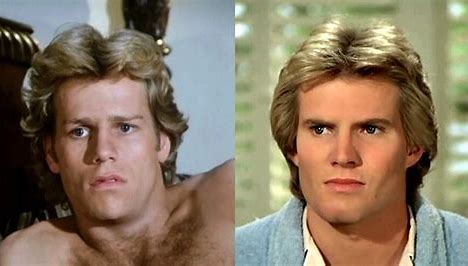
Dynasty premiered in 1981 with a gay character
TV series Dynasty premiered on this day in 1981. The show followed the trials and tribulations of the rich Carrington family. In the debut episode it was revealed that son Steven Carrington, played by Al Corley (pictured left), was gay.
At the time there few LGBTIQ characters on television, so the inclusion of a gay character on a new prime-time show was noteable.

Despite identifying as gay, Steven has relationships with both men and women throughout the series run.
After two season Corley quit the role saying he was frustrated by the character’s ever shifting sexuality. The next year actor Jack Coleman (Pictured right) took over the part and played Steven through to 1988.
Prior to joining Dynasty Coleman a memorable role on Days of Lives where he played Jake Kositchek, who was revealed to be the Salem Strangler, one of the shows long running story lines. More recently he’s been seen in Heroes, The Office, The Vampire Diaries and Castle.
When the show had a reunion special in 1991 Coleman was not available, and Corley returned to the role. In the shows 2017 reboot James McKay played the role.

Queen Elizabeth I reintroduced laws against buggery
On this day in 1564 Queen Elizabeth I reintroduced laws against buggery. Her father Henry the Eighth was the first British monarch to introduce specific laws against anal sex in 1533, but they had been repealed when his daughter Mary took the throne twenty years later.
The punishment for those caught breaking the law was death.
The 1533 Buggery act remained on the law books until 1828, when it was replaced by the ‘Offences Against the Person Act’, which covered a wide range of sexual related offences. Homosexual sex would remain illegal in Britain until 1967.
When Australia was settled by the British the 1533 Buggery Act became part of Australian law. Victoria was the last state to remove the death penalty for anal sex, that happened in 1949. In 1997 Tasmania was the last Australian state to remove laws outlawing homosexuality.
Britain allows gays and lesbians in the military
It was in 2000 that the United Kingdom lifted it’s ban on gay and lesbian people serving in the military. Australia removed the discrimination in 1992, but the USA retained their ‘Don’t Ask, Don’t Tell’ policy until 2011.
An episode of The Golden Girls led to the show’s writers getting death threats
In 1991 an episode of the comedy series The Golden Girls caused a controversy.
The popular show featured Bea Arthur, Betty White, Rue McClanahan and Estelle Getty playing four women of a certain age who become house mates. They respectively played the memorable characters of Dorothy, Rose, Blanche and Sophia.
During the shows sixth season the episode Sister of the Bride saw the character of Blanche dealing with accepting that he brother Clayton is gay. The previous season the writer’s had introduced Clayton and he’d let his sister know that he was gay.
Producers thought it would it would be a great idea to bring the character played by actor Monte Markham back. While Blanche had told her brother she had no problem with his sexuality, viewers soon saw that she wasn’t being completely honest. Her views are challenged further when Clayton and his boyfriend Doug announce they are getting married.
In an interview in 2025 writer Marc Cherry, who worked on the show revealed that the landmark episode had led to the writing team getting death threats.
“They called us up to the office a few days after the episode aired, and they said, ‘So you guys are getting death threats.’” Cheery recalled.
Cherry also shared that he was shocked to get a letter that was antisemitic.
“I thought that’s weird – I’m not Jewish.” he said.
Soon the writers were having to get their phone numbers unlisted to avoid the insulting phone calls.
Cherry said despite the death threats it was a privilege to be writer television that was groundbreaking for its time. He’d go on to have huge success in the TV industry creating the long running show Desperate Housewives.
This post was first published in 2020 and been subsequently updated.