

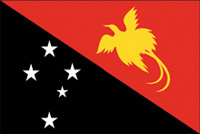
Papua New Guinea is a study in diversity. In a country with a total land area of just over 462,000 square kilometers, and a population of around 5 and a half million, there are a myriad of cultural groups and societies. With over 800 separate languages and innumerable social structures, beliefs and practices, it is virtually impossible to generalize about life in Papua New Guinea. Attitudes towards sex and sexuality are no exception.

Most societies in Papua New Guinea are patriarchal and afford women little status. In some, women are considered so lowly as to be highly undesirable as sexual partners. As a result, many single men engage in sex with other men, and married men have sex with their wives only when strictly necessary – whilst maintaining minimal physical contact and following thorough purification rituals. At the other end of the spectrum are the few matriarchal societies where women hold the power, societies where it is an honour for a woman to have group sex with multiple men throughout a night. In some societies sex is seen as dirty and shameful, in others it is celebrated with pre- and extra-marital sex encouraged. Same-sex activity between young boys and girls is common in some societies; however, it is seen strictly as meaningless play. Many also contain initiation traditions for young men that involve ritualized homosexuality. This, of course, is all interpreted through a Western lens – in Papua New Guinea, few people or behaviours are consciously labeled as ‘gay’ or ‘straight’.
There is one commonality in all this, however, and it’s a worrying one – the rapid rise in HIV infections throughout the country. 60,000 are already infected, representing 90% of the region’s total HIV cases. And with the rate of transmission increasing by 30% annually, there is real concern that Papua New Guinea could be on the brink of an epidemic similar to the one currently gripping Africa. Heterosexual activity accounts for the majority of transmission and the risks are increased by the high level of sexual assault that occurs in the country, the prevalence of concurrent sexual relationships and the young age at which most become sexually active. Compounding the problem is that more than 75% of those infected are unable to access treatment, a symptom of the widespread poverty and unemployment in the country.
Possibly the most dangerous factor however is the widespread stigma, fear and mis-education that exists about HIV/AIDS. The issue was brought sharply into focus recently when unconfirmed reports surfaced of HIV positive people being buried alive. The reports have since been vigorously denied, but the rumours persist. So do stories of morgue workers refusing to handle the bodies of those who have died and health workers being equally reluctant with work with infected persons. UNAIDS is currently working with the Papua New Guinean government to address the HIV/AIDS situation in the country and has identified the implementation of programs to actively address stigma as one of the priority platforms in the country’s response. Left unchecked, stigma will fuel the spread of HIV/AIDS, prevent those infected from accessing and receiving appropriate treatment and likely even lead to human rights violations against people who are, or are suspected of being infected with HIV/AIDS. Given Australia’s relative success at tackling HIV/AIDS stigma one hopes that governmental and health authorities here can assist one of our nearest neighbors in averting a human disaster.